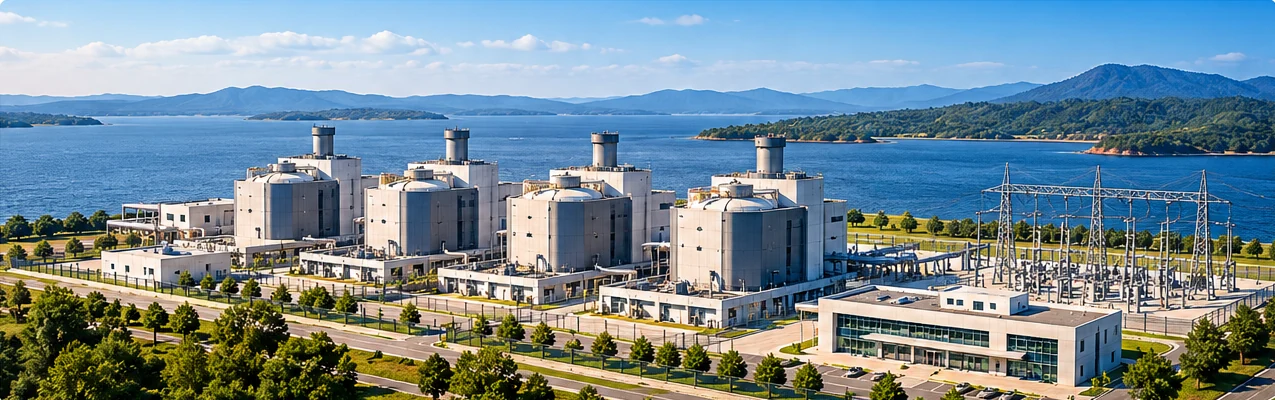
The July 21, 2026 fire at Excelerate Energy-managed floating LNG terminal off Maheshkhali was a reminder of how third-party interference and technical breakdowns can impact the Bangladesh energy security. Disruption of essential systems disrupted daily gas delivery of around 450 million cubic feet, hitting power plants, industries, industrialists and domestic users. The uproar was accompanied by uncertainty in international LNG markets which came as a result of tensions near the Strait of Hormuz which complicated the process of obtaining energy even further.
These changes highlight one of the long-running weaknesses of Bangladesh: how to provide stable sources of energy and sustain growing demand, dependence on imports in the global fuel prices and to control the financial effects of the price swings. They also give an interesting background to the appraisal of other sources of electricity that may supplement the current energy infrastructure in the nation.
The possibility of deploying small modular reactors (SMRs) with capacities of around 300-400 megawatts has been taken into active cooperation of the Government. Rosatom Russia also made an offer of floating nuclear power unit to Bangladesh at a conference in Moscow in June. Such developments imply that the nation is starting to check how nuclear technology can help it in the longer-term energy diversification.
Potential of SMRs are not completely novel to Bangladesh. I got opportunity to attend the International Atomic Energy Agency (IAEA) 17th INPRO Dialogue Forum on Small Modular Reactors in Ulsan, South Korea, in July 2019. The international experts discussions revealed potential uses in countries with comparatively modest electricity grids and desired opportunities and challenges of financing, regulation, safety and technological preparedness. Most of those considerations have become all the more relevant to Bangladesh seven years later.
The share of natural gas in the electricity production in Bangladesh is around 64 percent and the decreasing domestic production has raised the value of the imported LNG. In 2025, the imports made in the country were about 327.8 billion cubic feet of LNG at the reported cost of about 3.8 billion dollars. The growth in renewable energy is increasing, but its proportion to the total electricity production is rather low.
The Rooppur Nuclear Power Plant is a significant step towards these structural challenges. Two VVER-1200 reactors with a total generation capacity of 2400 MW are expected to make a significant addition to the electricity generation in the country, when fully commissioned. The attempt to have a grid connection within the first unit is also stressed in recent discussions between Bangladesh and Rosatom. Another point that Rooppur considers to be necessary is the connection between the single generating units and the ability of the national electricity grid.
An individual 1,200 MW reactor is a high concentration of generation capacity. The highest electricity demand was registered to 16,604 MW in Bangladesh on May 10, 2025. With seven percent of the demand, that would be a single Rooppur unit at that level. In times of less demand, it would have a much higher relative share.
It is widely appreciated by nuclear power planning internationally that it must consider the vulnerability of the grid to the loss of the largest generating unit in a short period of time. This involves sufficient operating back-up supplies, transmission facilities and grid stability facilities. The October 2022 national blackout showed that it is essential to have a robust transmission network that can handle disruptions in multiple areas all linked to one another.
SMRs can be used as a potentially useful upgrade to capacity in the future. Incremental introduction of reactors that generate about 100-300 MW would enable the capacity of generation to be increased with the increase in electricity demand and development of transmission infrastructure. Their relatively smaller unit generation might also enable the sudden failure of a generating unit to be easier handled subject to proper design of the system.
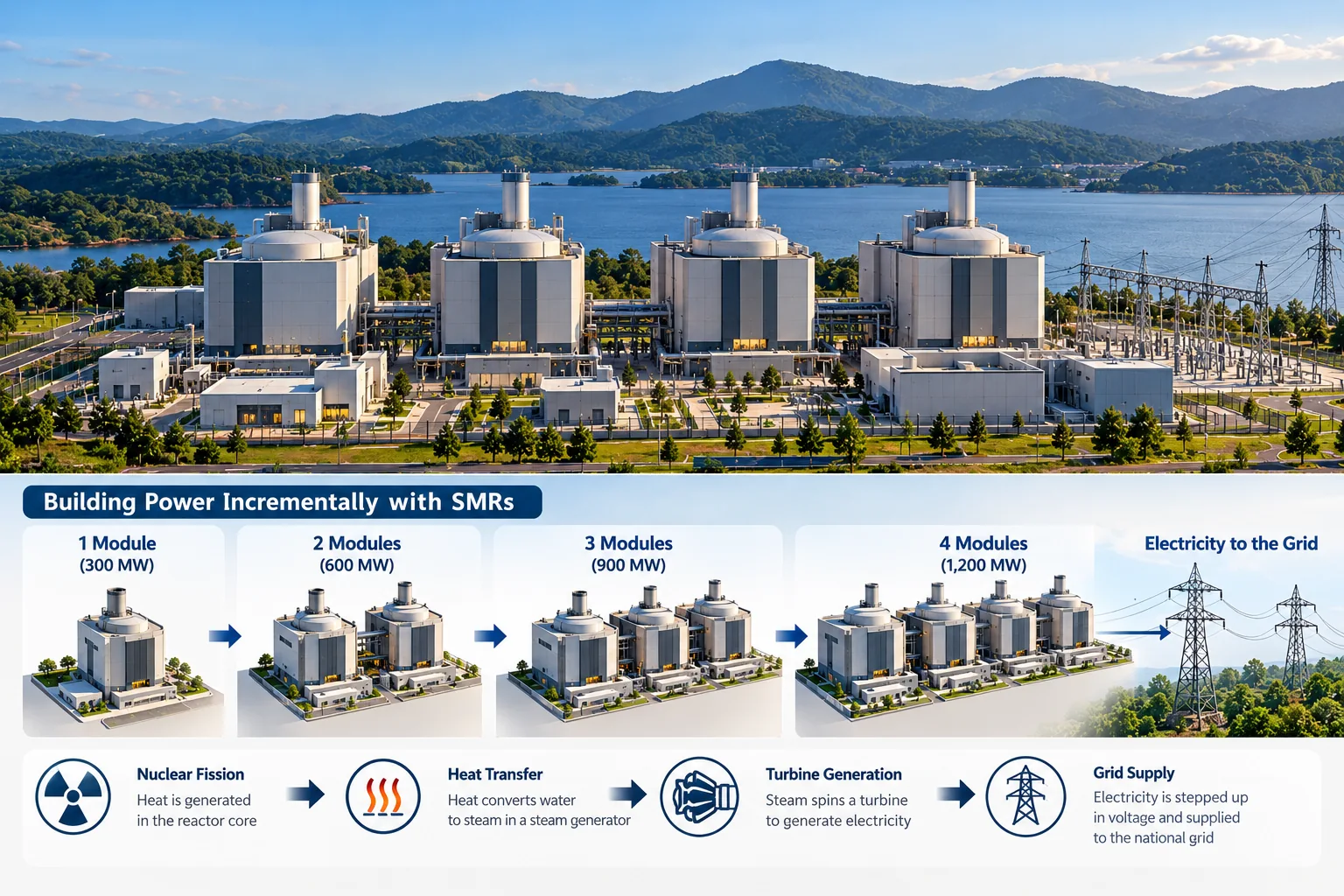
The other possible benefit is flexibility. Multi-unit SMR reactors can enable operators to regulate generation in individual reactor units which can be used to augment variable renewable generation sources like solar energy. Some designs also have passive safety provisions, aimed at keeping the necessary cooling processes operational with less active supplies.
The foreign experience is promising, even though commercial implementation is still in its infancy. A floating nuclear power station Akademik Lomonosov, two 35 MW reactors, has been operational commercially since May 2020 in Russia. In the year 2023, China commissioned its HTR-PM demonstration plant at Shidaowan which produced about 200 MW of electricity. The 125 MW Linglong One reactor in Hainan, China, has passed cold functional testing in October 2025, and is on track to become operational.
There are other countries notifying their programmes. Canada approved construction of the GE Vernova Hitachi BWRX-300 reactor of Darlington in April 2025, which is planned to be operational in about 2030. In June 2026, Uzbekistan started construction of a RITM-200N unit based on the design by Rosatom. Other SMR technologies being sought are in the United Kingdom, South Korea, the United States and India.
The difference between the technological promise and the proven commercial performance is especially significant, though, to a developing economy.
A key element of the economic case of SMRs is the expectation that standardised factory production and repetition will cut down construction costs, construction timelines. The SMRs will enjoy economies of series, unlike the conventional large reactors that enjoy economies of scale. Nevertheless, it has not yet been proven that such savings are evident in a consistent manner in commercial projects.
Reliable operation experience, open cost estimates and reliable fuel supply, maintenance and ultimate decommissioning arrangements should therefore be given special consideration by Bangladesh. Small reactor does not necessarily imply the cheaply-priced electricity. Its economic feasibility should be compared to other technologies in terms of generating power, financing, transmission, and the long term needs and projections of the country.
Equally worth considering, is supplier diversification. Through collaboration with Russia, Rooppur has already laid a significant groundwork on nuclear power programme of Bangladesh. These projects may be used in the future to develop the same experience and have technological partnerships with other countries. Clearly competitive analysis of available technologies might assist Bangladesh to compare the lifecycle prices, financing conditions, fuel-cycle requirements, sharing of knowledge and backing long term.
Institutional preparedness is also key. Bangladesh has also gained some useful experience in nuclear development with the 3 MW TRIGA Mark-II research reactor in Bangladesh Atomic Energy Commission which has been in use since 1986 in Savar, Bangladesh. I served there as a licensed reactor operator. Nonetheless, working on a research reactor even though it is experience, it cannot replace the specialised skills that are needed to license, build up and operate commercial nuclear power plants. Any new reactor technology would require the Bangladesh Atomic Energy Regulatory Authority (BAERA) to have adequate technical skills, institutional capacity and regulatory autonomy in order to review any technological changes.
It is important to not only consider location, but also conducting site-screening studies to identify potential places along major rivers, or even coastal regions not only to access demand centres.
All of this does not imply that SMRs ought to supplant domestic gas exploration, renewable energy, modernisation of transmission, or energy efficiency. Instead, they may comprise one of the elements of balanced energy policy where various technologies will meet various needs.
The experience that the Bangladesh had with Rooppur has already helped to create opportunities to train specialised human resources, support the development of nuclear institutions and enhance international cooperation of technology. Such advancements can be used to base on the assessment of the next generation of nuclear technologies.
The present day urgency should not include the decision to build an SMR. The best place to start will be an extensive national level feasibility test backed by independent technical analysis and consultation with mature international partners.
The ultimate nature of energy security is resilience, affordability and the capacity to withstand fluctuating conditions of reliable supply. With Bangladesh looking into its future electricity demand, small modular reactors should be examined with strong consideration, and specifically through evidence-based means, not as a solvo-panacea to all the energy requirements of Bangladesh, but rather as a potentially useful tool to add to the arsenal of the country energy needs.